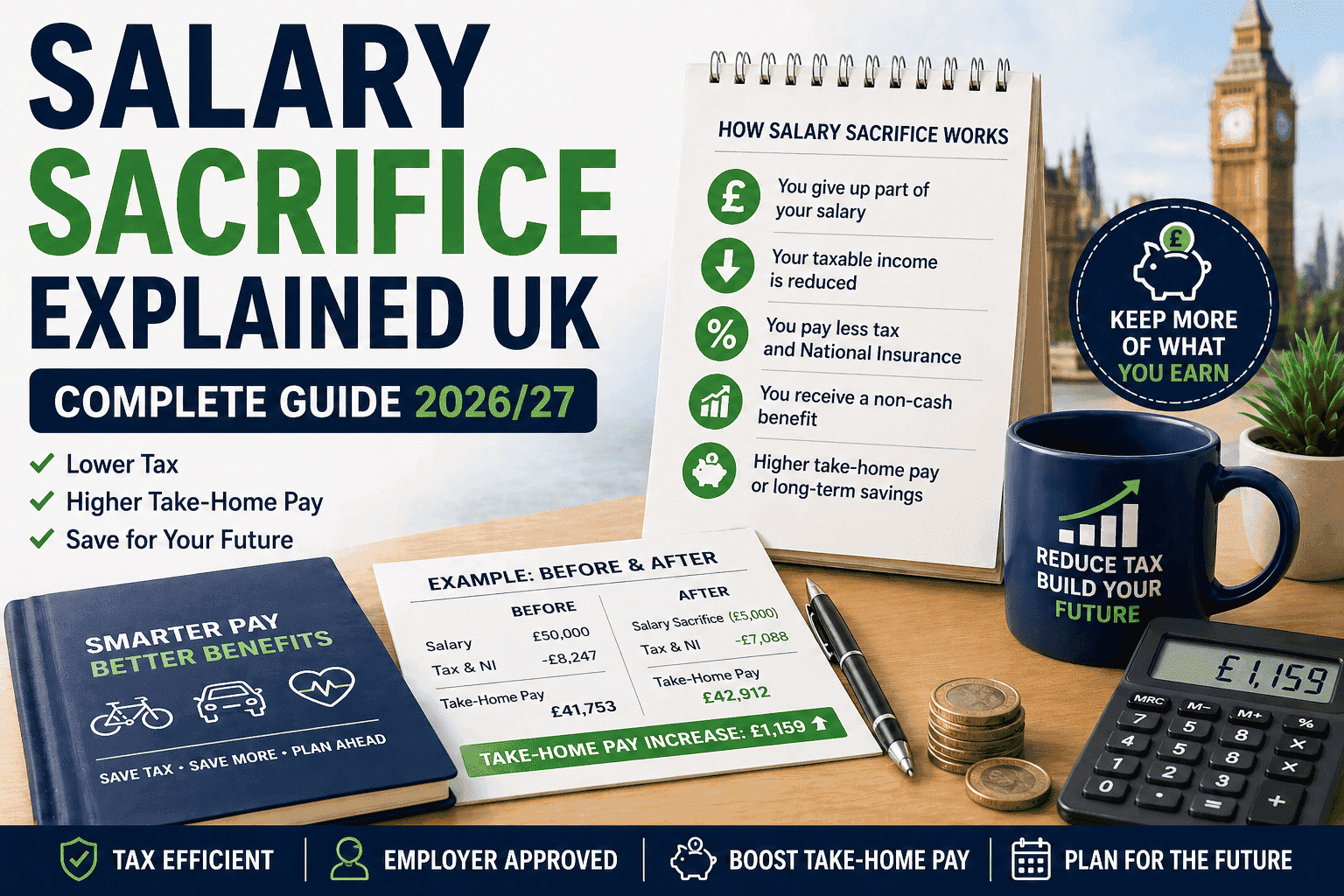
A UK employee earning £50,000 who increases their pension sacrifice by just 5% saves over £1,200 a year in tax and National Insurance. That's money that would otherwise go straight to HMRC — legally redirected into their pension instead.
Salary sacrifice is one of the most powerful financial tools available to UK employees. Yet most people either don't use it, don't use it enough, or don't fully understand how it works.
This is the complete guide for 2026/27.
What is salary sacrifice?
Salary sacrifice is a formal agreement between you and your employer to reduce your gross salary in exchange for a non-cash benefit. The most common benefit is pension contributions, but it also covers electric vehicles, cycle-to-work schemes, and childcare.
The critical point: your gross pay is reduced before income tax and National Insurance are calculated. This means you pay tax on a smaller number — and that's where the savings come from.
It is not a pay cut. Your total compensation stays the same. You simply receive part of it as a pension contribution (or other benefit) rather than cash.
How it differs from a normal pension contribution
There are two ways to pay into a workplace pension:
Relief at source — you contribute from your net (after-tax) pay, and HMRC adds 20% tax relief back into your pension. Higher rate taxpayers can claim an additional 20% via Self Assessment.
Salary sacrifice — your gross pay is reduced before tax and NI are applied. You save both income tax and National Insurance on the sacrificed amount.
Salary sacrifice is more efficient for most employees because it saves NI as well as income tax. Relief at source only saves income tax.
How much can you actually save?
The saving depends on your income tax rate and NI rate. Here are three real examples for 2026/27.
Example 1: £35,000 salary — basic rate taxpayer
Sarah earns £35,000 and increases her pension sacrifice by £150/month (£1,800/year).
| Before | After | |
|---|---|---|
| Gross salary | £35,000 | £33,200 |
| Income tax | £4,486 | £4,126 |
| National Insurance | £1,794 | £1,650 |
| Take-home pay | £28,720 | £27,524 |
| Net cost of £1,800 sacrifice | — | £1,196 |
Sarah puts £1,800 into her pension but it only costs her £1,196 in take-home pay. The government subsidises £604 of it through tax and NI relief.
Example 2: £60,000 salary — higher rate taxpayer
James earns £60,000 and sacrifices an extra £5,000/year into his pension.
| Before | After | |
|---|---|---|
| Gross salary | £60,000 | £55,000 |
| Income tax | £11,432 | £9,432 |
| National Insurance | £2,194 | £2,094 |
| Take-home pay | £46,374 | £43,474 |
| Net cost of £5,000 sacrifice | — | £2,900 |
James contributes £5,000 to his pension at a real cost of just £2,900. The effective saving rate is 42% — 40% income tax plus 2% NI.
Example 3: £80,000 salary — higher rate taxpayer with Child Benefit
Emma earns £80,000 and has two children. She currently receives Child Benefit but pays it all back through the High Income Child Benefit Charge (HICBC).
By sacrificing £20,000/year, Emma reduces her Adjusted Net Income to £60,000 — the threshold below which no HICBC applies.
| Saving | Amount |
|---|---|
| Income tax saving (40%) | £8,000 |
| NI saving (2%) | £400 |
| Child Benefit restored (2 children) | £2,212 |
| Total annual benefit | £10,612 |
The £20,000 sacrifice costs Emma approximately £11,600 in take-home pay but delivers £10,612 in combined tax, NI, and Child Benefit savings — plus £20,000 going into her pension.
The employer NI bonus
Here is something most employees don't know: when you sacrifice salary, your employer also saves National Insurance.
Employers pay 13.8% NI on your earnings above £9,100/year. When you sacrifice £5,000, your employer saves:
£5,000 × 13.8% = £690
Many employers have a policy of passing some or all of this saving back into your pension. It costs them nothing extra — they're simply sharing a saving they've already made.
Always ask your HR or payroll team whether your employer has an NI sharing policy. If they don't, it's worth raising. The saving is real and it's yours to negotiate.
What can you sacrifice?
Salary sacrifice is not limited to pensions. The most common benefits in 2026/27 are:
Pension contributions — the most widely available and most tax-efficient. Reduces gross pay, saving income tax and NI.
Electric vehicle leasing — one of the most valuable benefits currently available. The Benefit in Kind rate for fully electric vehicles is just 3% in 2026/27, making EV salary sacrifice extremely tax-efficient. A basic rate taxpayer can save 30–40% on the cost of leasing an EV.
Cycle to Work — save 32–42% on a bike and accessories up to £1,000 (or more with some schemes). Reduces gross pay, saving income tax and NI.
Childcare vouchers — the legacy scheme is closed to new entrants but still running for existing members. Worth up to £933/year in tax and NI savings for basic rate taxpayers.
Technology schemes — some employers offer laptops, phones, and other tech via salary sacrifice.
Who benefits most?
Salary sacrifice benefits everyone who pays income tax and NI, but the savings are largest for:
Higher rate taxpayers (£50,271–£125,140) — save 40% income tax plus 2% NI = 42% per £1 sacrificed.
Earners in the £100k–£125,140 Personal Allowance taper zone — the effective marginal rate is 60% in this band. Every £1 sacrificed saves 60p in tax. See our £100k tax trap guide for the full explanation.
Parents earning £60,000–£80,000 — salary sacrifice can eliminate the High Income Child Benefit Charge entirely. See our Child Benefit guide for worked examples.
Anyone with a student loan — salary sacrifice reduces gross pay, which reduces student loan repayments (since repayments are calculated on income above the threshold).
The Annual Allowance limit
You can contribute up to £60,000 per year into your pension (or 100% of your earnings, whichever is lower). This is the Annual Allowance and it includes both your contributions and your employer's contributions.
Most employees are nowhere near this limit. But if you're making large additional contributions — particularly if you're trying to bring income below £100,000 — it's worth checking.
If you have unused Annual Allowance from the previous three tax years, you may be able to carry it forward and contribute more than £60,000 in a single year.
Step-by-step: how to set up salary sacrifice
Step 1: Check your employer offers it
Most medium and large employers offer salary sacrifice pension arrangements. Smaller employers may not. Check your employee handbook or ask HR.
Step 2: Calculate how much to sacrifice
Use the TaxCal UK calculator to model different sacrifice amounts. You can see exactly how each amount affects your take-home pay, tax, NI, and — if relevant — your Child Benefit position.
Step 3: Contact HR or payroll
Request an increase in your salary sacrifice pension contribution. This is a change to your employment contract, so it requires a formal agreement. Most employers process this within one to two pay periods.
Step 4: Check your payslip
Once the change is in place, your payslip should show a lower gross salary and lower tax and NI deductions. The pension contribution should appear as an employer contribution (since it's paid directly by your employer on your behalf).
Step 5: Review annually
Review your sacrifice amount at the start of each tax year. If your salary has increased, you may want to increase your sacrifice to maintain the same percentage — or to take advantage of new thresholds.
Important considerations
Mortgage affordability — some lenders assess affordability based on your gross salary after sacrifice, which will be lower. If you're planning to apply for a mortgage or remortgage, check with your adviser before making large changes.
State Pension and benefits — salary sacrifice reduces your gross pay, which means lower NI contributions. If you're close to retirement and haven't yet built up 35 qualifying years of NI contributions, check your NI record at gov.uk before making large sacrifices.
Minimum wage — your post-sacrifice salary cannot fall below the National Living Wage. This is only relevant for lower earners making large sacrifices.
Statutory pay — Statutory Maternity Pay, Paternity Pay, and Sick Pay are calculated on your post-sacrifice salary. If you're planning to take parental leave, consider this before increasing your sacrifice.
What this means for you
If you're a basic rate taxpayer, every £100 you sacrifice into your pension costs you just £72 in take-home pay. The other £28 comes from tax and NI relief.
If you're a higher rate taxpayer, every £100 sacrifice costs you £58. The other £42 is effectively a government subsidy.
If you're in the £100k–£125,140 taper zone, every £100 sacrifice costs you just £40. The effective saving rate is 60%.
These are not small numbers. Over a working lifetime, the difference between using salary sacrifice efficiently and not using it at all can amount to tens of thousands of pounds in your pension pot.
Frequently asked questions
Can I sacrifice my entire salary?
No. Your post-sacrifice salary cannot fall below the National Living Wage (£12.21/hour in 2026/27). In practice, most employees sacrifice a percentage of salary rather than a fixed amount, which keeps them well above this limit.
Does salary sacrifice affect my employer's pension contribution?
It depends on your employer's scheme rules. Some employers calculate their contribution as a percentage of your post-sacrifice salary, which would reduce their contribution. Others calculate it on your original salary. Check your scheme rules or ask HR.
Can I change my sacrifice amount?
Yes, but the frequency of changes depends on your employer's policy. Most allow changes once or twice a year; some allow monthly changes.
Is salary sacrifice the same as a SIPP?
No. A SIPP (Self-Invested Personal Pension) is a type of pension account. Salary sacrifice is a method of contributing to a pension. You can contribute to a SIPP via salary sacrifice if your employer supports it, but most workplace salary sacrifice schemes use the employer's chosen pension provider.
What happens if I leave my job?
Your salary sacrifice arrangement ends when you leave. Your pension pot stays with the pension provider and you can transfer it to a new employer's scheme or a personal pension.
Summary
- Salary sacrifice reduces your gross pay before tax and NI are calculated
- Basic rate taxpayers save 28% on every £1 sacrificed; higher rate taxpayers save 42%
- Earners in the £100k–£125,140 taper zone save 60% — the most valuable band
- Employer NI savings (13.8%) may be passed back to you — always ask
- EV leasing and cycle-to-work are also available via salary sacrifice
- Use the TaxCal UK calculator to model your exact savings
FAQ
Can I sacrifice my entire salary into a pension?
No. Your post-sacrifice salary cannot fall below the National Living Wage (£12.21/hr in 2026/27). In practice, most employees sacrifice a percentage of salary rather than a fixed amount.
Does salary sacrifice affect my employer's pension contribution?
It depends on your scheme rules. Some employers calculate their contribution on your post-sacrifice salary; others use your original salary. Check your scheme documentation or ask HR.
Is salary sacrifice available to all UK employees?
No. Your employer must offer it. Most medium and large employers do; smaller employers may not. It is worth asking HR if it is not currently offered.
Can I change my sacrifice amount during the year?
Yes, but the frequency depends on your employer's policy. Most allow changes once or twice a year; some allow monthly changes.
Does salary sacrifice affect Statutory Maternity Pay?
Yes. SMP is calculated on your post-sacrifice salary, which will be lower. If you are planning to take maternity leave, consider this before increasing your sacrifice.
Free Calculator
Calculate your exact salary sacrifice savings
Free UK calculator. Enter your salary, pension % and tax code to see your personal breakdown.
Calculate My Tax SavingsRecommended Tools
Consolidate your old pensions into one simple online plan.
Stocks & Shares ISA with low fees and smart diversification.
Free, impartial pension guidance from the UK government.
* Some links may be affiliate links. We may earn a commission at no cost to you.