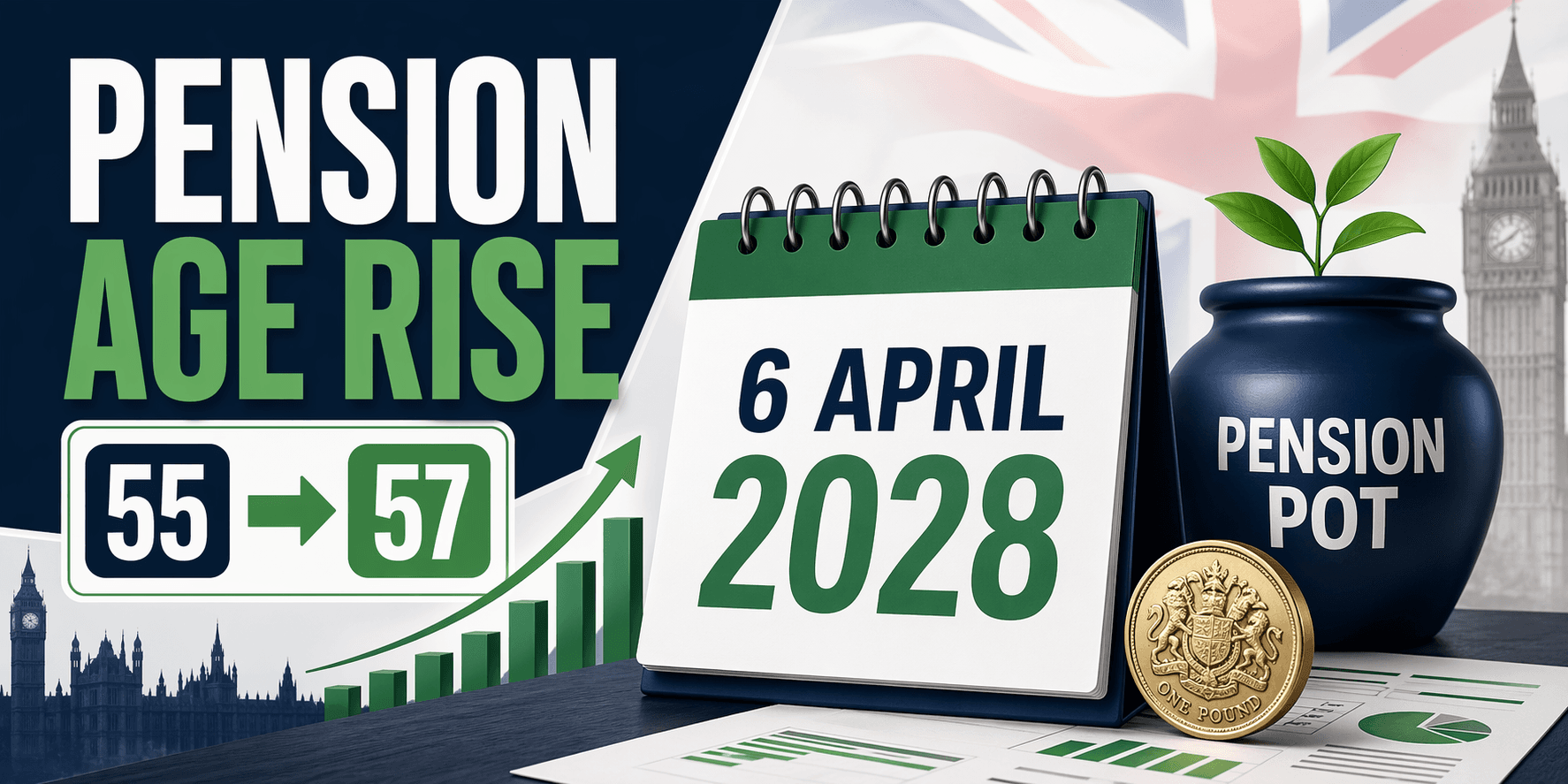
If you plan to use your pension at 55, this change could leave a two-year cash gap.
For someone expecting £12,548 a year from the full new State Pension, one extra year of waiting is already a £12,548 delay. For private pension access, the HMRC pension age increase could mean waiting until 57, not 55.
That is not a small admin change. It could decide whether you can reduce hours, retire early, clear debt, or bridge a career break.
Calculate your tax impact
Use the calculator to see how pension salary sacrifice changes your take-home pay and retirement saving.
What is happening?
The normal minimum pension age is rising from 55 to 57 on 6 April 2028.
This is the earliest age most people can access a workplace or personal pension without triggering unauthorised payment tax charges.
It is not exactly the same as the State Pension age.
The State Pension age is also rising from 66 to 67 between 2026 and 2028. That separate timetable affects when you can claim State Pension payments.
Together, the two changes mean many UK workers need to think harder about the years between stopping work and receiving pension income.
Why this matters
The headline risk is simple: your retirement plan may have a missing income year, or even two.
If you expected to use private pension money from 55, but your earliest access age becomes 57, you may need to cover:
- mortgage or rent
- bills and food
- travel and insurance
- support for children or parents
- a gap before State Pension age
That money has to come from somewhere.
For many employees earning £30,000 to £150,000, the answer may be a mix of pension salary sacrifice, ISAs, cash savings, and a realistic target retirement age.
Who is affected?
You are most likely to be affected by the HMRC pension age increase if:
- you have a workplace pension or personal pension
- you do not have a protected pension age
- you expected to access pension savings at 55
- you turn 55 after the rule changes on 6 April 2028
- you are planning early retirement, semi-retirement, or a career break
People in some uniformed public service schemes, such as firefighters, police, and armed forces schemes, are treated differently under the published rules.
Some pension savers may also have a protected pension age, depending on scheme rules and transfer history. You should check this directly with your provider before making decisions.
The two pension age increases people are mixing up
There are two separate changes behind the current search interest.
1. Private pension access age: 55 to 57
From 6 April 2028, the normal minimum pension age rises to 57 for most registered pension schemes.
This affects when you can normally access defined contribution pensions, including many workplace pensions, SIPPs, and personal pensions.
2. State Pension age: 66 to 67
The State Pension age is increasing from 66 to 67 between 2026 and 2028.
For people born from 6 March 1961 to 5 April 1977, the State Pension age is generally 67 under the current timetable.
That matters because the State Pension cannot normally be taken early. If you stop work before State Pension age, you need another source of income.
Real example: the £25,096 retirement gap
Imagine you planned to retire at 55 and use pension income of £12,548 a year as part of your bridge.
That annual figure is roughly the full new State Pension rate for 2026/27, used here as a simple planning benchmark.
If your private pension access age moves from 55 to 57, you may need to fund two extra years before you can use that pension:
| Gap | Annual income needed | Total bridge needed |
|---|---|---|
| 1 year | £12,548 | £12,548 |
| 2 years | £12,548 | £25,096 |
That is the cash-flow problem. The pension money may still be yours, but the access date moves.
See how much you can save
Try the calculator to estimate how salary sacrifice could build your pension while reducing tax and National Insurance.
£60k salary example: how salary sacrifice can help
Say you earn £60,000 and increase pension salary sacrifice by £10,000 in the 2026/27 tax year.
Most of that sacrificed pay would otherwise sit in the higher-rate tax band. In a typical England, Wales, or Northern Ireland scenario, sacrificing £10,000 could save around:
| Item | Approximate impact |
|---|---|
| Pension contribution added | £10,000 |
| Income tax and employee NI saved | about £4,160 |
| Take-home pay reduction | about £5,840 |
In plain English: you may be able to put £10,000 into your pension while your take-home pay falls by around £5,840.
If your employer also shares some of their employer National Insurance saving, the pension boost could be higher.
These are estimates. Your actual result depends on your tax code, country, student loan plan, pension setup, benefits, and employer rules.
What this means for you
The pension age rise does not mean you should panic.
It does mean you should stop assuming that age 55 is automatically available.
For a 35, 40, or 45-year-old employee, the key question is not just "how much is in my pension?"
It is also:
- when can I access it?
- what happens before then?
- will my ISA or cash savings bridge the gap?
- how much can I afford to sacrifice now?
- will I lose child benefit or personal allowance if I do nothing?
For higher earners, pension contributions can also reduce adjusted net income, which matters for the 100k tax trap and the child benefit guide.
What you should do now
Start with your pension provider, not a guess.
Ask:
- What is the earliest age I can access this pension?
- Do I have a protected pension age?
- Would transferring this pension affect that protection?
- Can I access part of the pension before 57 if I already started the process before 6 April 2028?
- What fees, investment choices, and drawdown rules apply?
HMRC's April 2026 pension schemes newsletter says transitional regulations are still being prepared, so some details may be refined before 2028.
That makes checking your actual scheme rules even more important.
How to reduce the impact
There are three practical levers.
Build a bridge outside your pension
If you want flexibility before age 57, pensions are not the only tool.
Cash savings and ISAs can help cover the years before pension access. They may not give the same upfront tax relief as pension contributions, but they can be accessed earlier.
Use salary sacrifice while you are earning
Salary sacrifice can reduce taxable pay and employee National Insurance, while increasing pension contributions.
This can be especially useful if you earn around:
- £50,000 to £60,000, where child benefit and higher-rate tax can bite
- £80,000, where higher-rate tax savings make pension contributions powerful
- £100,000 to £125,140, where the personal allowance taper can create a very high effective tax rate
Read the salary sacrifice guide for the basics before changing contributions.
Avoid transferring blindly
If you have a protected pension age, a transfer could affect it.
Do not move an old pension just because a new platform looks cheaper or easier. First check whether access terms would change.
For larger pots or early-retirement plans, consider regulated financial advice.
Quick checklist
- Check your State Pension age on GOV.UK.
- Ask every pension provider for your earliest access age.
- Find out whether any scheme has a protected pension age.
- Build an ISA or cash bridge if you want flexibility before 57.
- Model salary sacrifice before increasing contributions.
- Keep records of pension transfers and scheme access rules.
Free Calculator
Try the calculator
Use TaxCal UK to estimate your income tax, National Insurance, pension salary sacrifice impact, and take-home pay.
Calculate My Tax SavingsTry the TaxCal UK calculator to estimate your take-home pay.
FAQ
Is HMRC increasing the pension age to 57?
Yes. The normal minimum pension age for most registered pension schemes rises from 55 to 57 on 6 April 2028. This is the age at which most pension benefits can normally be accessed without unauthorised payment tax charges.
Is this the same as the State Pension age increase?
No. The private pension access age and State Pension age are different rules. Private pension access rises to 57 in 2028 for most people. The State Pension age is rising from 66 to 67 between 2026 and 2028.
Can I still take my pension at 55?
Some people may still be able to, especially if they reach 55 before the change or have a protected pension age. The rules depend on your scheme and circumstances, so check directly with your pension provider.
How much could the pension age increase cost me?
It depends on how much income you expected to take before age 57. As a simple example, needing £12,548 a year for two years creates a £25,096 bridge requirement.
Can salary sacrifice reduce the impact?
Salary sacrifice can help you build pension savings more tax-efficiently while you are working. It can reduce income tax and National Insurance, but it may also affect take-home pay, mortgage affordability, and some workplace benefits.
Should I transfer my pension before 2028?
Do not transfer purely because of the pension age change. If you have a protected pension age, transferring could affect your access rights. Check scheme rules and consider regulated advice before moving a pension.
Recommended Tools
Consolidate your old pensions into one simple online plan.
Stocks & Shares ISA with low fees and smart diversification.
Free, impartial pension guidance from the UK government.
* Some links may be affiliate links. We may earn a commission at no cost to you.
This article is for general information only and is not financial or tax advice. Tax rules may change and your personal circumstances will affect the result. Always check your pension scheme rules and consider qualified advice before making retirement decisions.
Use the UK Salary Sacrifice Calculator to see your exact savings in seconds